
Artist Spotlight & Signature Prototypes, Boutique Electronics & Tone Shaping, Custom Guitar Atelier Design, Customer Reviews, International Shipping & Global Logistics, The Bespoke Build Process (E-E-A-T), Tonewood & Material Science
Guitar Setup Checklist: How to Check Neck Relief, String Action & Intonation at Home
Nov
Even the finest tonewoods and precision hardware will feel stiff or sound slightly out of tune up the neck if your guitar setup drifts out of balance. Seasonal humidity shifts, string gauge changes, and regular stage play gradually affect neck curvature, bridge height, and intonation. Knowing how to walk through a basic guitar setup checklist helps you keep your electric, bass, or acoustic instrument playing smoothly and spot when a quick adjustment is needed.
1. Start With Fresh Strings & Accurate Tuning
Never evaluate or adjust neck relief, string action, or intonation on old, worn strings. Oxidized or unevenly stretched strings vibrate unpredictably and throw off intonation measurements across the fretboard.
- Install a fresh set of strings in your preferred gauge and tuning.
- Stretch each string gently along the center of the neck and bring the instrument up to exact concert pitch in your normal playing position (strapped on or resting on your lap, not flat on a workbench).
2. Check Neck Relief (Truss Rod Curvature)
Neck relief refers to the slight forward bow in the neck that gives vibrating strings room to ring cleanly without buzzing against the frets:
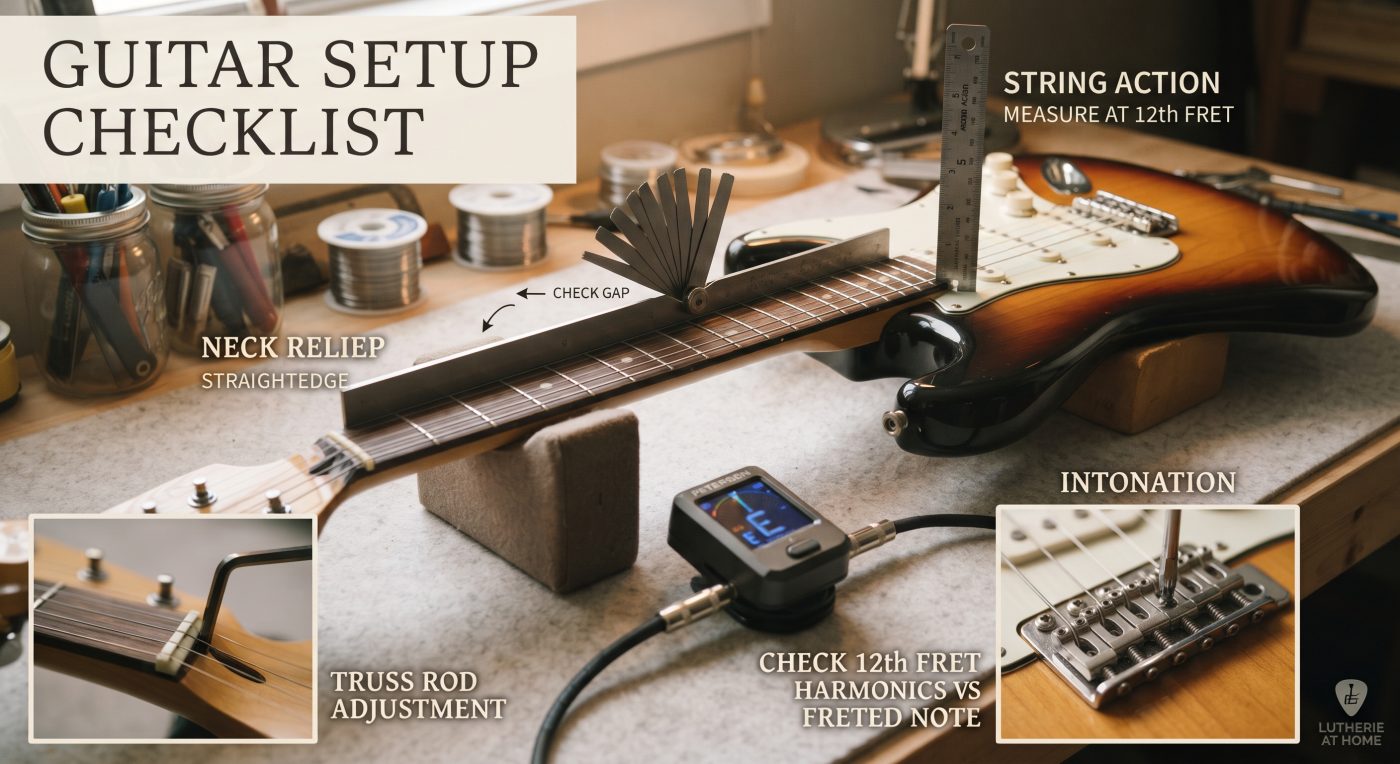
- How to Check: Hold down the low E string at the 1st fret with your fretting hand and at the 14th or 15th fret(where the neck meets the body) with your picking-hand thumb or a capo.
- What to Look For: Tap the string gently above the 7th or 8th fret. You should see and feel a tiny gap—roughly the thickness of a thin business card or about 0.008″ to 0.010″—between the bottom of the string and the top of the fret wire.
- What It Means: If the string sits completely flush against the 7th fret, the neck is too flat or back-bowed (which causes open-position fret buzz). If there is a large gap, the neck has excessive forward bow (which makes fretting in the middle of the neck feel high and stiff). Any truss rod adjustment should be made in tiny 1/8-turn increments, letting the wood settle before re-checking.
3. Measure String Action at the 12th Fret
String action is the height of the strings above the 12th fret wire, controlled primarily by bridge saddle height (and nut slot depth for the first few frets):
- Low Action: Easier fretting, faster legato runs, and lighter left-hand fatigue—ideal for clean technique, though very aggressive picking may produce light fret rattle.
- Medium to High Action: Allows heavier pick attack, wider vibrato, and clean slide work without choking notes.
- Balanced Reference Range: On most standard electric guitars, players often target around 1.5 mm (1/16″) on the high E string and 2.0 mm (5/64″) on the low E string at the 12th fret, adjusted to match your fretwork, neck radius, and playing style.
4. Verify Intonation Up the Fretboard
If your open chords sound in tune while chords played above the 12th fret sound sharp or flat, your intonation needs saddle length adjustment:
- Play the 12th-fret harmonic on each string and tune it precisely to pitch using an accurate chromatic tuner.
- Next, fret that same string cleanly at the 12th fret (without pressing too hard or bending the string) and compare the tuner reading:
- If the fretted note is SHARP: Lengthen the string by moving the bridge saddle slightly back (away from the neck).
- If the fretted note is FLAT: Shorten the string by moving the bridge saddle slightly forward (toward the neck).
- Retune the open string after each saddle adjustment and repeat until the 12th-fret harmonic and fretted note match cleanly.
5. Inspect Nut Slots, Pickups & Hardware
- First-Fret Action: Fret a string at the 3rd fret and check the tiny clearance over the 1st fret. Properly cut nut slots keep first-position chords comfortable and in tune.
- Pickup Height: Keep magnetic pickups low enough that their magnetic pull does not warble string sustain on upper frets, while balancing volume across all strings.
Precision Setup Built Into Every Custom Instrument
At Custom Guitar Atelier (the musical instrument and custom guitar division of Everline General Merchandise LLC, continuing over 25 years of lutherie heritage since 2000), every custom electric, bass, and acoustic instrument completes full assembly, precision setup, and our CGA 50-Point Quality Check before dispatch—backed by actual photographs and a professional demonstration video of your completed guitar.
- Explore Custom Instruments: Custom Guitar Atelier Official Website
- Read Musician Stories & Watch Videos: Customer Reviews: Real Stories from Musicians Who Trust Custom Guitar Atelier