
Artist Spotlight & Signature Prototypes, Boutique Electronics & Tone Shaping, Custom Guitar Atelier Design, Custom Guitars, International Shipping & Global Logistics, The Bespoke Build Process (E-E-A-T), Tonewood & Material Science
The Double-Neck Acoustic Guitar: 6-String and 12-String Versatility in One Custom Instrument
Aug
Some songs call for the familiar clarity of a traditional 6-string acoustic guitar. Others come alive with the rich, shimmering character of a 12-string.
A double-neck acoustic guitar gives the player access to both.
At Custom Guitar Atelier, our custom 6-string and 12-string double-neck acoustic guitar combines two distinct acoustic voices into one striking instrument—giving musicians greater flexibility for live performance, composition, recording, and creative arrangements.
It is not simply two guitar necks attached to one body.
It is an instrument designed for musicians who want to move between two different acoustic textures without changing guitars.
What Is a Double-Neck Acoustic Guitar?
A double-neck acoustic guitar combines two separate playable necks within one acoustic instrument.
In a 6-string / 12-string configuration, one neck provides the familiar feel and response of a standard acoustic guitar, while the other provides the wider, naturally layered sound associated with a 12-string.
This allows the musician to move between:
- 6-string rhythm playing
- 12-string accompaniment
- Fingerstyle passages
- Open chords
- Arpeggios
- Alternate textures within the same song
- Different tunings between the two necks
- Live arrangements that would otherwise require two guitars
For musicians who regularly use both 6-string and 12-string acoustic sounds, the double-neck design can become an exceptionally useful performance instrument.
Two Acoustic Voices in One Guitar
The greatest advantage of the 6-string / 12-string double-neck configuration is the contrast between the two necks.
The 6-String Neck
The standard 6-string side provides the familiar response guitarists already know.
It can be used for:
- Chord accompaniment
- Fingerstyle playing
- Flatpicking
- Melody lines
- Acoustic solos
- Alternate tunings
- Percussive acoustic techniques
- Traditional singer-songwriter arrangements
Its simpler string configuration also makes it ideal for sections where clarity, control, or more precise single-note playing is required.
The 12-String Neck
The 12-string side provides a broader and more complex sound.
Its paired strings create additional harmonic content and natural chorus-like richness.
This makes the 12-string neck especially effective for:
- Expansive open chords
- Shimmering rhythm parts
- Arpeggiated passages
- Atmospheric intros
- Folk and acoustic rock arrangements
- Layered accompaniment
- Songs requiring a larger acoustic presence
With both necks available on the same instrument, the musician does not have to choose between these sounds.
Why Use a Double-Neck Acoustic Guitar?
A double-neck acoustic guitar becomes particularly valuable when a song requires two different acoustic characters.
Imagine beginning with a full 12-string introduction and then moving into a more focused 6-string verse.
Or using the 6-string for a fingerpicked section before transitioning into a broad 12-string chorus.
With separate instruments, the player would need to stop and change guitars.
With a double neck, the transition can happen immediately.
This can be particularly useful for:
- Live performers
- Progressive acoustic musicians
- Singer-songwriters
- Multi-instrumentalists
- Studio musicians
- Acoustic rock players
- Folk musicians
- Worship musicians
- Experimental guitarists
For the right arrangement, the double neck becomes part of the composition itself.
A Visually Distinctive Acoustic Instrument
A double-neck acoustic guitar has an unmistakable appearance.
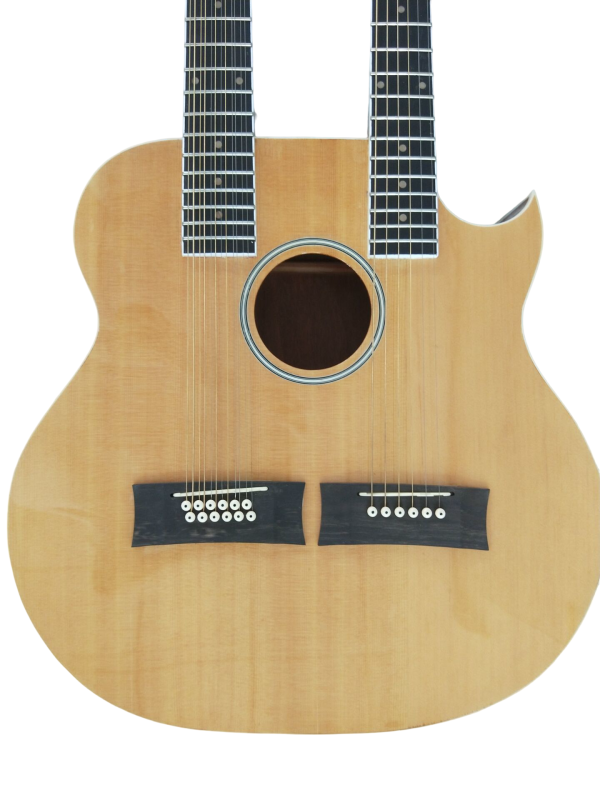
The reference instrument shown here features a natural acoustic top, two separate bridges, two fretboards, and a cutaway-style body design.
From the front, the two necks immediately define the instrument’s identity.
From the rear, the twin neck construction becomes even more apparent, along with the separate tuner arrangements required for the 6-string and 12-string sections.
The result is an instrument that commands attention before a single note is played.
For live musicians, that visual presence can become part of the performance.
For collectors, it can make the instrument an especially distinctive addition to a guitar collection.
The Importance of Balance in a Double-Neck Design
A double-neck guitar introduces challenges that do not exist in a conventional acoustic instrument.
There is more hardware.
There are more strings.
There are two necks.
There are two bridges.
And the entire instrument must still work as a unified guitar.
This makes considerations such as weight distribution, neck placement, body proportions, bridge positioning, and structural stability especially important.
A successful double-neck acoustic guitar should not simply look impressive.
It should allow the player to move naturally between both necks and use the instrument as a practical musical tool.
6-String and 12-String for Live Performance
One of the strongest reasons to choose a double-neck acoustic guitar is live versatility.
Musicians often build arrangements around different guitar textures.
A 12-string may be perfect for an opening passage but too dense for a later verse.
A 6-string may provide better definition for fingerstyle playing but lack the expansive shimmer required for a chorus.
With both necks immediately available, the musician can design the performance around the song rather than around the limitations of one guitar.
This also eliminates the need to keep two separate acoustic guitars within immediate reach on stage.
A Creative Tool for Songwriters
A double-neck acoustic guitar can also influence the songwriting process.
Having two separate string configurations encourages experimentation.
A songwriter can build one section around a conventional 6-string tuning and another around the 12-string neck.
The two necks may also be configured differently depending on the player’s requirements.
This opens possibilities involving:
- Standard tuning
- Alternate tunings
- Open tunings
- Drone-based arrangements
- Different capo positions
- Contrasting chord voicings
- Layered acoustic textures
Instead of treating the second neck merely as an additional feature, musicians can use it as part of the composition itself.
Fingerstyle and Acoustic Arrangement Possibilities
Fingerstyle musicians often think in layers.
Bass notes.
Chords.
Melodies.
Harmonics.
Percussive elements.
A double-neck acoustic guitar introduces another layer of possibility.
The 6-string neck can provide precision and familiar spacing for detailed fingerstyle work.
The 12-string neck can provide broader harmonic texture for passages requiring a more expansive sound.
This allows one instrument to support very different approaches within the same performance.
Natural Acoustic Character
The natural-finish instrument shown in the reference images emphasizes the character of the wood and the traditional acoustic aesthetic.
This type of finish can be especially effective on an unusual instrument.
The design itself already attracts attention, so the natural appearance allows the construction and proportions of the guitar to remain the visual focus.
For customers who prefer a different aesthetic, a custom build can provide opportunities to discuss alternative colors, stains, decorative details, and other finishing requirements depending on the design.
Cutaway Access
The reference design incorporates a cutaway-style body shape on the treble side.
This helps visually accommodate the dual-neck format while also supporting access toward the upper portions of the fretboards.
For players who use melodic lines, extended chord voicings, or higher-register acoustic passages, upper-fret access can be an important consideration.
Customization Is Part of the Instrument
A double-neck acoustic guitar is already a specialized instrument, making customization particularly relevant.
Different musicians may have very different requirements.
One player may want a traditional natural finish.
Another may prefer a darker burst.
One musician may want a particular neck profile.
Another may prioritize specific fret dimensions or string spacing.
Depending on the build and technical feasibility, customers may discuss preferences involving:
- Body and neck woods
- Fretboard materials
- Finish
- Neck profile
- Scale length
- Fret size
- Inlays
- Hardware
- Tuning preferences
- Electronics or acoustic-electric requirements
- Playing orientation
- Decorative details
- Other special specifications
At Custom Guitar Atelier, the objective is to create an instrument around the player’s requirements rather than force every musician into one fixed configuration.
Right-Handed and Left-Handed Possibilities
Specialized instruments can be difficult to find for left-handed musicians.
That is especially true with double-neck acoustics.
A custom build can provide the opportunity to discuss either right-handed or left-handed orientation, depending on the instrument design and production feasibility.
The playing orientation should be considered as part of the overall instrument rather than treated as an afterthought.
Acoustic-Electric Options
Some players want a double-neck acoustic guitar primarily for unplugged use.
Others intend to perform on stage or record through an amplified system.
For those musicians, acoustic-electric options may be considered depending on the requested configuration.
Because a double-neck instrument contains two separate string systems, electronics should be planned carefully around the player’s intended use.
Customers who require amplification should communicate their requirements when placing the custom order.
Why Custom Production Takes Time
A double-neck acoustic guitar is considerably more complex than a conventional acoustic guitar.
There are more components to prepare, more structural elements to align, additional fretwork, additional tuners, dual bridges, more strings, and a larger number of setup considerations.
Production also involves finishing, curing, assembly, inspection, final setup, and playability testing.
This is why a custom instrument should be viewed as a build process rather than an off-the-shelf purchase.
During production, customers can receive updates as their instrument progresses through important stages.
Once completed, the instrument must also pass final quality inspection before being approved for shipment.
Quality Control Before Shipment
A custom double-neck acoustic guitar must function as a complete instrument—not simply as two necks sharing one body.
Before shipment, key areas should be checked carefully, including:
- Construction and finish
- Neck condition and alignment
- Fretwork
- Playability
- Tuning
- Intonation
- String action
- Bridge and hardware installation
- Functional performance
- Final cosmetic condition
At Custom Guitar Atelier, completed custom instruments undergo our comprehensive quality inspection, final setup, and playability testing before shipment.
Learn more about our quality-control process:
Built for Musicians Who Want More from an Acoustic Guitar
A conventional acoustic guitar is one of the most versatile instruments ever created.
A double-neck acoustic does not replace it.
It expands the possibilities.
The player gains access to two different string configurations without leaving the instrument.
A focused 6-string sound.
A shimmering 12-string character.
Two necks.
One acoustic platform.
And a completely different way to approach arrangements and performance.
Your Double-Neck Acoustic Guitar, Your Specifications
Perhaps you want a natural 6-string / 12-string double-neck acoustic similar to the instrument shown here.
Perhaps you want different woods.
A different finish.
Custom inlays.
A left-handed configuration.
Acoustic-electric electronics.
Different neck specifications.
Or an entirely original design.
That is where custom building begins.
At Custom Guitar Atelier, we work with musicians who want an instrument developed around their preferred specifications.
Share your requirements, reference photographs, drawings, or design ideas, and our team can review the possibilities for your custom build.
Discover the Custom Eclipse Double-Neck Acoustic Guitar
Explore our Custom Eclipse Double-Neck Acoustic Guitar – 6-String / 12-String and discover an acoustic instrument designed for musicians who want greater versatility from a single guitar.
Whether you perform live, compose, record, collect unique instruments, or simply want an acoustic guitar that offers something beyond the conventional format, a double-neck acoustic provides a distinctive combination of sound, function, and visual identity.
Custom Guitar Atelier
Crafted for Your Hands. Built for Your Sound.