
Artist Spotlight & Signature Prototypes, Boutique Electronics & Tone Shaping, Custom Guitars, International Shipping & Global Logistics, The Bespoke Build Process (E-E-A-T), Tonewood & Material Science
The Art of the Custom Acoustic Guitar: Where Tonewood, Craftsmanship, and Personal Expression Meet
Aug
An acoustic guitar is one of the most organic musical instruments ever created. There are no amplifiers required to give it its fundamental voice, no effects pedals necessary to create its natural character, and no electronics needed to make the strings resonate through the room.
At its heart, an acoustic guitar is wood, strings, craftsmanship, and the hands of the musician.
At Custom Guitar Atelier, we believe that makes the selection of every component especially important. A custom acoustic guitar should not simply look beautiful. Its tonewoods, construction, dimensions, appointments, and playing characteristics should work together to create an instrument suited to the musician who will own it.
Why Choose a Custom Acoustic Guitar?
Mass-produced acoustic guitars are designed around standardized specifications. That approach works for many musicians, but every guitarist is different.
One player may prefer a powerful dreadnought-style instrument with strong projection and a commanding low end. Another may want a more intimate acoustic with excellent note definition for fingerstyle playing. Some musicians prioritize warmth and sustain, while others seek clarity, responsiveness, or greater headroom for aggressive strumming.
A custom build provides an opportunity to make these decisions intentionally.
Depending on the design, a player can personalize elements such as:
- Body shape and dimensions
- Top, back, and side tonewoods
- Neck wood and profile
- Fingerboard and bridge material
- Scale length
- Nut width
- Fret specifications
- Binding
- Rosette
- Inlays
- Hardware
- Finish
- Decorative artwork and other available appointments
The objective is not customization simply for its own sake. It is to create an acoustic guitar in which sound, feel, appearance, and personality belong together.
The Sound Begins With the Top
The soundboard is among the most influential components of an acoustic guitar.
When the strings vibrate, their energy is transferred through the bridge to the top. The soundboard responds to that energy and helps produce the acoustic voice of the instrument.
This is why premium solid tonewoods are so highly valued in acoustic guitar construction.
Solid Spruce
Spruce remains one of the classic choices for acoustic guitar tops because of its balance of strength, responsiveness, clarity, and dynamic range.
A quality solid spruce top can work exceptionally well for musicians who move between delicate playing and powerful strumming. It can provide clear articulation while retaining the headroom needed when the instrument is played more aggressively.
For a versatile custom acoustic guitar, AAA solid spruce can be an excellent foundation.
The Character of Rosewood
If the top plays a major role in producing the instrument’s voice, the back and sides contribute significantly to its overall tonal character.
Solid rosewood has long been associated with premium acoustic instruments.
Rosewood is often chosen by players seeking a rich acoustic character with substantial low-end presence, articulate highs, sustain, and harmonic complexity.
Pairing a solid spruce top with solid rosewood back and sides creates one of the most established premium tonewood combinations in acoustic guitar construction.
It is a pairing suited to many musical applications—from accompaniment and strumming to detailed fingerstyle passages.
Mahogany: Stability, Feel, and Musical Character
Mahogany is another important tonewood in guitar construction and is frequently used for acoustic guitar necks.
A well-constructed mahogany neck provides a strong and stable foundation while maintaining a comfortable feel in the player’s hands.
The neck should never be considered merely a structural connection between the headstock and body. Neck profile, thickness, scale length, fretwork, and setup can dramatically affect how an acoustic guitar feels.
This is one of the major advantages of commissioning a custom instrument: playability can be considered alongside appearance and tone.
Ebony for the Fingerboard and Bridge
Premium acoustic builds frequently incorporate ebony for the fingerboard and bridge.
Ebony is dense, durable, visually elegant, and well suited to components that must withstand years of playing.
Its naturally dark appearance also creates a sophisticated visual contrast against lighter soundboards such as spruce, particularly when combined with detailed binding and inlay work.
These details may appear small individually, but together they contribute significantly to the tactile and visual character of a premium instrument.
The Importance of a Bone Nut and Saddle
The nut and saddle are relatively small components, but they occupy critical points in the string path.
A traditional premium specification is bone for both the nut and saddle.
Proper material selection must be accompanied by precise shaping, slotting, fitting, and setup. In custom guitar building, execution matters just as much as the material itself.
A premium tonewood specification cannot compensate for poor fretwork, an improperly cut nut, inaccurate intonation, or an unsuitable setup.
That is why the complete instrument must be considered as a system.
Real Abalone: Craftsmanship You Can See
A custom acoustic guitar can also become a canvas for artistic expression.
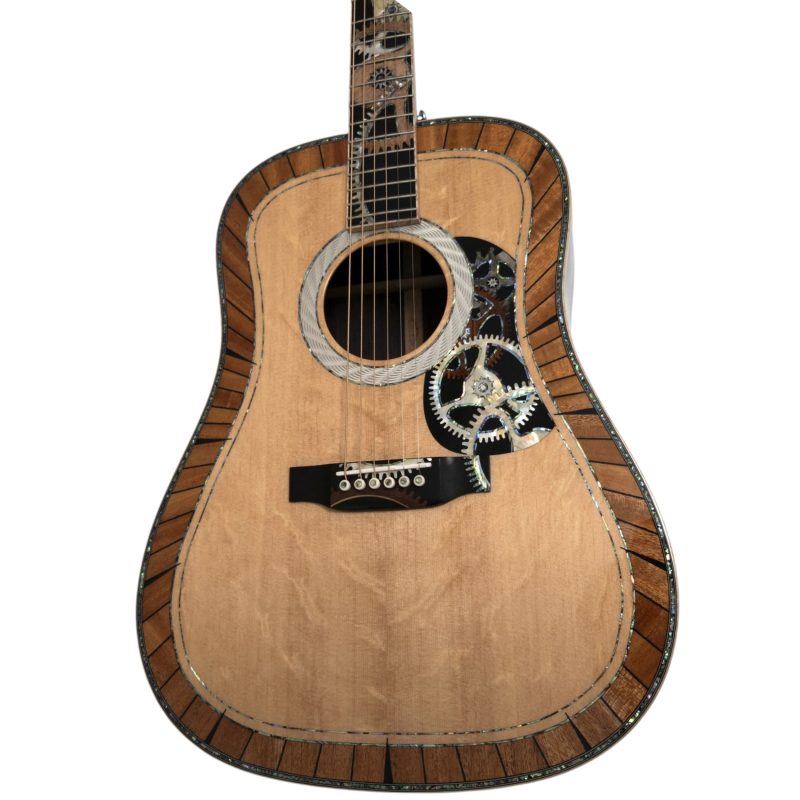
Real abalone inlays and binding can transform an otherwise traditional instrument into something immediately distinctive.
Under changing light, abalone reveals variations of green, blue, turquoise, violet, and other natural tones. Because it is a natural material, its visual character cannot be perfectly replicated from one piece to another.
It can be incorporated into areas such as:
- Body binding
- Rosettes
- Fingerboard inlays
- Headstock details
- Decorative borders
- Custom artistic elements
When used with restraint and careful workmanship, abalone can provide an unmistakably premium appearance without overwhelming the natural beauty of the tonewood.
When an Acoustic Guitar Becomes Art
Customization can go considerably further than selecting woods and hardware.
Intricate wood inlays, personalized fretboard designs, elaborate back artwork, decorative motifs, and individually commissioned concepts can turn an acoustic guitar into a functional work of art.
For collectors, this creates another dimension to the instrument.
The guitar is still intended to make music—but it also represents the personality, imagination, and aesthetic preferences of its owner.
At Custom Guitar Atelier, we welcome customers who arrive with unconventional ideas.
A concept can begin with something as simple as a photograph, drawing, artwork, or description. From there, the design can be developed around what is practical for the instrument while preserving the customer’s original vision.
A Custom Guitar Should Be Personal
There is no single specification that represents the “perfect” acoustic guitar.
The right instrument depends on the player.
A musician who primarily performs fingerstyle arrangements may have different priorities from a singer-songwriter who strums heavily. A studio musician may prioritize tonal versatility, while a collector may place greater emphasis on rare woods, elaborate inlays, or an extraordinary visual concept.
This is why we believe a custom build should begin with a conversation.
How do you play?
What kind of sound are you looking for?
What body style feels comfortable?
Which woods and finishes appeal to you?
Do you prefer traditional elegance or something completely unique?
The answers help define the instrument.
Premium Materials Deserve Careful Craftsmanship
Terms such as solid wood, AAA tonewood, ebony, rosewood, and abalone are important—but premium materials alone do not create a premium guitar.
The quality of the finished instrument depends on how those materials are selected, joined, shaped, finished, assembled, and set up.
A beautiful piece of spruce must become a responsive soundboard.
A piece of rosewood must become part of a resonant acoustic body.
An ebony fingerboard requires accurate fretwork.
Decorative inlays must complement the instrument rather than compromise its functionality.
Ultimately, materials and craftsmanship must work together.
Build an Acoustic Guitar Around Your Vision
A custom acoustic guitar represents something increasingly rare: an instrument created around an individual rather than an individual adapting to a standardized instrument.
Whether your ideal guitar is understated and traditional or highly artistic and unmistakably unique, Custom Guitar Atelier can help develop your concept into a personalized instrument.
Choose your preferred tonewoods. Explore different appointments. Consider custom inlays, finishes, hardware, and artistic details. Send us a photograph, drawing, reference instrument, or simply describe the guitar you have imagined.
Your next acoustic guitar does not have to be one of thousands made to the same specification.
It can be built specifically for you.
Explore Custom-Made Acoustic Guitars
Custom Guitar Atelier
Crafted for Your Hands. Built for Your Sound.