
Artist Spotlight & Signature Prototypes, Boutique Electronics & Tone Shaping, Custom Guitar Atelier Design, International Shipping & Global Logistics, The Bespoke Build Process (E-E-A-T), Tonewood & Material Science
How to Choose a Custom Guitar or Bass: Tonewoods, Pickups, Hardware & Custom Build Options
Oct
Choosing a custom guitar or custom bass gives you something a standard production instrument cannot always provide: the ability to select specifications around your preferred sound, playing style, appearance, and performance requirements.
At Custom Guitar Atelier, every custom build begins with the player’s specifications. From body and neck woods to pickups, hardware, fretboard materials, finishes, inlays, and electronics, the objective is to create an instrument that works as a complete system rather than simply combining a collection of parts.
If you are considering ordering a custom electric guitar or bass, this guide explains the most important specifications to consider before your build begins.
1. Start With the Sound and Playing Style You Want
Before choosing colors, hardware, or decorative features, consider how you want the instrument to sound and feel.
A player looking for articulate clean tones may have very different requirements from someone building a guitar for high-gain metal. Likewise, a bassist looking for a warm vintage character may choose a different pickup and tonewood combination from a player who wants a modern, aggressive bass tone.
Consider:
- Your primary music style
- Clean versus high-gain playing
- Rhythm versus lead playing
- Preferred sustain and resonance
- Desired pickup output
- Neck shape and playing feel
- Number of strings
- Scale length
- Fixed bridge versus tremolo
- Active versus passive electronics
A good custom build begins by considering how these specifications work together.
2. Choosing the Right Tonewoods
Tonewood selection affects much more than appearance. Wood choice can influence the instrument’s weight, resonance, stability, feel, and overall response.
At Custom Guitar Atelier, we use premium selected tonewoods, including materials sourced from Japan depending on the model and build requirements.
Alder
Alder is widely used for electric guitar bodies because of its relatively balanced response and comfortable weight.
It is a strong choice for players looking for a versatile instrument that can work across many styles.
Ash
Ash is often selected when a player wants pronounced grain patterns as well as a responsive, articulate instrument.
It is particularly attractive for transparent and natural finishes where the wood grain becomes part of the design.
Maple
Maple is commonly used for guitar and bass necks because of its strength and stability.
It can also be used as a body top, including figured varieties such as:
- Flame Maple
- Quilt Maple
- Spalted Maple
A figured maple top can dramatically change the appearance of a custom instrument.
Mahogany
Mahogany is traditionally associated with a warm, full-bodied character and is commonly selected for heavier rock-oriented guitar designs.
Walnut
Walnut offers distinctive natural grain patterns and is particularly attractive for custom basses, natural finishes, and boutique-style instruments.
3. Selecting the Fretboard
Your fretboard affects both the appearance and feel of the instrument.
Common options include:
Rosewood
Rosewood remains a popular choice because of its familiar feel, darker appearance, and traditional guitar aesthetic.
Ebony
Ebony offers a smooth playing surface and a premium dark appearance.
For many of our custom builds, an ebony fretboard is available as an upgrade.
Maple
Maple provides a lighter visual appearance and is frequently used for guitars with a more traditional or contemporary design.
Your fretboard can also be customized with:
- Dot markers
- Block inlays
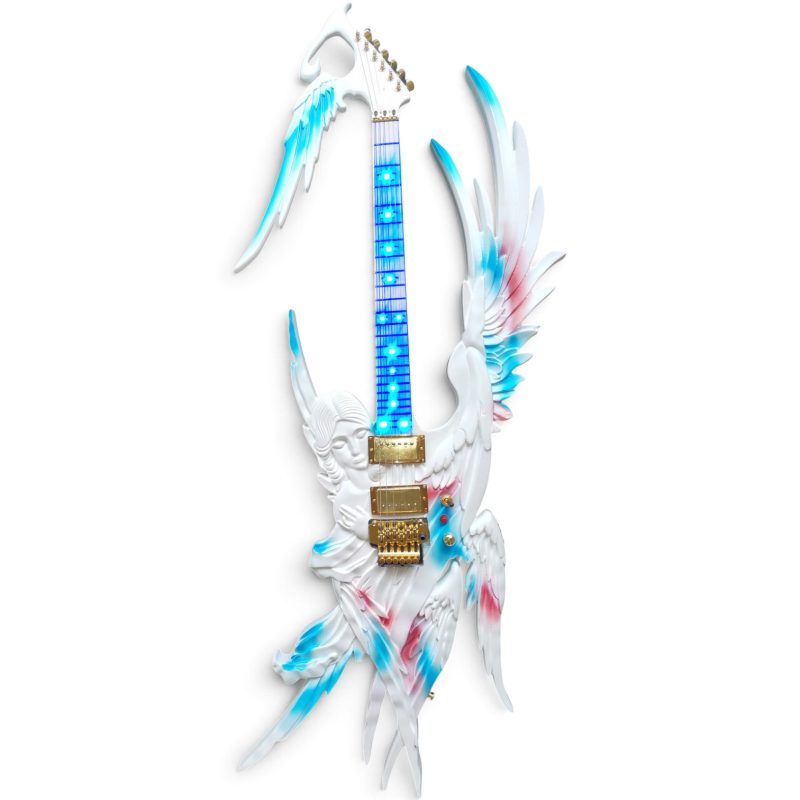
- Custom artwork
- Decorative patterns
- Logo-style inlays
- Side position markers
Depending on the design, our Production Team and Master Guitar Luthier can review custom inlay requests before production.
4. Choosing Guitar Pickups
Pickups are among the most important components in determining the amplified character of an electric guitar or bass.
Our standard configurations can use Wilkinson pickups and components manufactured in Korea, depending on the model.
We also offer premium pickup upgrades and customization using brands such as:
- EMG – USA
- Seymour Duncan – USA
- DiMarzio
- Fishman Fluence
- TV Jones
- MEC
Availability depends on the particular model, routing requirements, pickup configuration, and customer specifications.
Humbuckers
Humbuckers are a popular option for players who want fuller output and reduced electrical hum.
They are frequently selected for:
- Rock
- Hard rock
- Metal
- Blues
- Jazz
- High-gain applications
Single-Coil Pickups
Single coils are generally selected by players who want greater articulation, clarity, and attack.
H-S-H Configuration
An H-S-H configuration combines:
- Humbucker at the bridge
- Single coil in the middle
- Humbucker at the neck
This provides considerable tonal flexibility and is often chosen for modern performance-oriented guitars.
Active Pickups
Active pickup systems such as selected EMG models are popular with players seeking consistent output, clarity, and high-gain performance.
Because pickup installation can affect routing, electronics, wiring, and setup, the pickup configuration should ideally be confirmed before production begins.
5. Choosing Guitar Hardware
Hardware quality is critical to tuning stability, intonation, playability, and long-term reliability.
Depending on the selected configuration, Custom Guitar Atelier offers hardware from manufacturers including:
- Wilkinson – Korea
- Gotoh – Japan
- Schaller – Germany
- Grover
- Other premium component manufacturers depending on the build
Tuners
Locking tuners are a popular option because they can make string changes easier and help provide a secure string installation.
Many Custom Guitar Atelier configurations are available with Wilkinson locking tuners.
Premium Gotoh and Schaller options may also be available depending on the build.
Bridge
Your bridge choice has a major effect on setup and functionality.
Common configurations include:
- Fixed bridge
- Tune-O-Matic-style bridge
- Wraparound bridge
- Tremolo system
- Floyd Rose-style system
Premium bridge and tremolo upgrades may require additional routing, fitting, alignment, and setup.
For this reason, an upgraded hardware price represents more than simply the retail price of the component. A non-standard bridge or tremolo may require changes to the production template and additional installation and setup work.
6. Neck Specifications Matter
A custom guitar should not only look good—it needs to feel right in your hands.
Important neck specifications include:
- Scale length
- Nut width
- Neck thickness
- Fingerboard radius
- Number of frets
- Fret material
- Fret size
- Neck construction
- String spacing
Scale Length
Scale length influences string tension and playing feel.
A 25.5-inch scale, for example, is common on many modern electric guitars, while other guitar and bass designs use shorter or longer scales.
Stainless Steel Frets
Stainless steel frets are increasingly popular for premium custom guitars because of their durability and smooth feel.
Some Custom Guitar Atelier configurations are available with jumbo stainless steel frets.
Scalloped Frets
Partial fretboard scalloping is another customization option for specialized guitar designs.
For example, some performance-oriented instruments use scalloping on the highest frets to give the player’s fingers additional clearance during bends and lead playing.
7. Custom Guitar Finishes
One of the biggest advantages of a custom build is being able to choose an appearance that reflects your personal style.
Finish options can include:
- Solid colors
- Metallic finishes
- Transparent finishes
- Natural wood finishes
- Burst finishes
- High-gloss finishes
- Custom color combinations
Figured woods such as Flame Maple and Quilt Maple can also be paired with transparent finishes to emphasize the natural grain.
8. Hardware Color and Visual Details
Small details can significantly change the overall appearance of an instrument.
Hardware finishes may include:
- Chrome
- Nickel
- Black
- Gold
- Other finishes depending on component availability
You can also customize visual details such as:
- Pickguard material
- Control knobs
- Pickup covers
- Binding
- Inlays
- Headstock details
- Custom artwork
When specialized components are not commercially available in a particular finish, our Production Team can review possible alternatives.
9. Custom Guitar Electronics
Electronics should be planned together with your pickup configuration.
Options may include:
- Master volume
- Master tone
- Multiple volume controls
- Multiple tone controls
- Pickup blend controls
- 3-way selector
- 5-way selector
- Coil splitting
- Active electronics
- Passive electronics
A custom wiring configuration should be reviewed before production so the correct routing and control layout can be incorporated into the instrument.
10. Why We Complete the Instrument Before Quality Inspection
A custom guitar is not simply a collection of separately installed components.
The pickups, bridge, tuners, nut, electronics, neck, frets, and strings interact with one another.
For this reason, Custom Guitar Atelier normally completes the instrument with its confirmed hardware and electronics before final testing.
This enables our Production Team and Master Guitar Luthier to evaluate:
- Electronics operation
- Pickup installation
- String alignment
- Tuning stability
- Intonation
- Action
- Neck relief
- Hardware installation
- Control functionality
- Overall playability
- Cosmetic condition
The completed instrument then undergoes our CGA 50-Point Quality Inspection before it is approved for shipment.
11. Standard Components vs. Premium Upgrades
Not every custom guitar needs the most expensive components.
Our standard configurations are designed to provide a complete, functional instrument using selected components appropriate for the model.
Customers who want particular performance characteristics can then upgrade individual components.
For example:
Standard Configuration
- Selected premium tonewoods
- Wilkinson pickups and hardware depending on model
- Standard electronics
- Standard fretboard
- Standard finish
- Complete professional assembly and setup
Available Premium Upgrades
- EMG pickups
- Seymour Duncan pickups
- DiMarzio pickups
- Fishman Fluence pickups
- Gotoh hardware
- Schaller hardware
- Premium fretboard woods
- Stainless steel frets
- Custom inlays
- Specialized finishes
- Custom electronics
This allows you to determine where premium upgrades provide the greatest benefit for your particular instrument.
12. Custom Guitar vs. Mass-Produced Guitar
A mass-produced guitar is generally built around a predetermined specification.
A custom guitar takes the opposite approach.
Instead of changing your preferences to fit an existing instrument, you can choose specifications around your requirements.
A custom build can allow you to select:
- Body wood
- Neck wood
- Fretboard
- Scale length
- Pickups
- Electronics
- Bridge
- Tuners
- Hardware color
- Finish
- Inlays
- String configuration
- Other model-specific details
This makes custom construction particularly useful for musicians who already know what they like—or who cannot find their preferred combination of specifications in a standard production model.
13. Can Custom Guitar Atelier Build From a Reference Guitar?
Customers frequently send us reference photographs of guitars or basses that demonstrate the shape, finish, layout, or overall style they want.
These references can help our Production Team understand the requested design direction.
We then review the desired specifications and determine:
- Which features can be incorporated into the custom build.
- Which components are available.
- Whether routing or construction changes are required.
- Whether alternative components are recommended.
- Whether any additional customization charges apply.
The resulting instrument is a Custom Guitar Atelier custom build made to the customer’s confirmed specifications.
14. How Long Does a Custom Guitar Take to Build?
For many Custom Guitar Atelier projects, our typical production timeframe is approximately:
45–60 days
The exact timeframe depends on:
- Instrument design
- Customization requirements
- Component availability
- Finish
- Inlay work
- Hardware
- Electronics
- Final setup and inspection
International shipping time is separate from the production period.
For many destinations, estimated international shipping is approximately 10–15 days, although customs clearance and the destination country’s postal or courier processing can affect actual delivery time.
15. What Happens After You Order?
Once your specifications are confirmed, your custom instrument typically progresses through the following production stages:
- Order Confirmed and Specifications Reviewed
- Production Started
- Woodworking and Construction
- Finishing
- Hardware and Electronics Assembly
- Final Setup and CGA 50-Point Quality Inspection
- Ready for Shipment
- Shipped
Our team can provide production updates as the instrument progresses through these stages.
Frequently Asked Questions About Custom Guitars
Can I choose my own pickups?
Yes. Pickup options depend on the guitar or bass model and the required routing. We offer standard Wilkinson components on applicable models as well as premium options from brands including EMG, Seymour Duncan, DiMarzio, Fishman Fluence, TV Jones, and others.
Can I upgrade to an ebony fretboard?
Yes. Ebony is available for many of our custom builds, subject to the specifications of the individual instrument.
Can I select Gotoh or Schaller hardware?
Yes. Selected models can be upgraded with premium Gotoh hardware from Japan or Schaller hardware from Germany, depending on compatibility and availability.
Can you make a guitar based on photos?
Reference photographs can be submitted to our Production Team and Master Guitar Luthier. We review the design, construction requirements, components, and requested specifications before confirming feasibility.
Do you build custom bass guitars?
Yes. Custom Guitar Atelier builds both custom guitars and custom bass guitars, including 4-string, 5-string and other configurations depending on the project.
Are your instruments mass produced?
Our instruments are assembled as custom builds according to the specifications confirmed for each order rather than being sold only as fixed, off-the-shelf configurations.
Are custom guitars professionally set up?
Yes. The instrument is assembled, set up, tested, and reviewed through our quality-control process before shipment.
Build a Guitar Around Your Sound
A custom instrument should be more than a different color or pickup combination.
The tonewoods, neck, pickups, electronics, hardware, scale length, fretboard, bridge, finish, and setup should work together around the way you play.
At Custom Guitar Atelier, our goal is straightforward:
Crafted for Your Hands. Built for Your Sound.
Whether you are looking for a custom electric guitar, custom bass guitar, upgraded premium hardware, specialized pickup configuration, custom fretboard, or a complete instrument based around your own specifications, our Production Team can review your requirements and help determine the appropriate configuration.
To begin your custom build, send us your reference photos and preferred specifications.
Custom Guitar Atelier
Email: [email protected]
USA/Canada Toll-Free: 1 (800) 988-8340
Phone: +1 (520) 253-3353