
Artist Spotlight & Signature Prototypes, Boutique Electronics & Tone Shaping, Custom Guitar Atelier Design, International Shipping & Global Logistics, The Bespoke Build Process (E-E-A-T), Tonewood & Material Science
Right-Handed or Left-Handed Double Neck Guitar: Built for the Way You Play
Aug
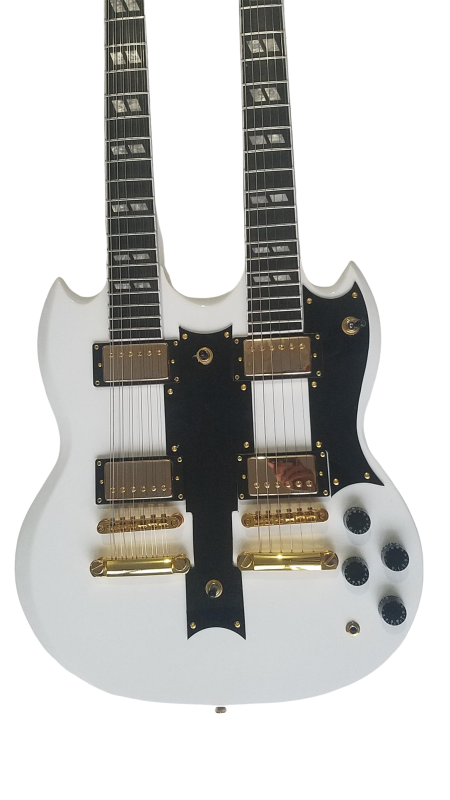
A double neck guitar is already one of the most distinctive instruments a musician can bring to the stage.
Two necks. Two playing ranges. Multiple tonal possibilities. One instrument.
But there is another factor that matters just as much as the number of strings, pickups, woods, or finish:
The instrument needs to be built for the player.
At Custom Guitar Atelier, our custom double-neck instruments can be configured for right-handed or left-handed players, allowing musicians to choose the orientation that matches the way they naturally perform.
Because a true custom instrument shouldn’t ask the musician to adapt to the guitar.
The guitar should be built around the musician.
What Is a Double Neck Guitar?
A double neck guitar combines two playable necks into a single instrument.
Rather than changing guitars during a song, the musician can move between two different string configurations while continuing to use the same instrument.
Depending on the design, a double neck may combine configurations such as:
- 6-string guitar and 12-string guitar
- 4-string bass and 6-string guitar
- 4-string bass and 12-string guitar
- Different electric guitar configurations
- Acoustic double-neck configurations
- Other customized combinations
Custom Guitar Atelier’s current collection includes double-neck instruments such as 4-string bass/12-string guitarmodels as well as 4-string bass/6-string guitar configurations.
The concept gives players access to sounds and playing roles that would normally require two separate instruments.
Why Play a Double Neck Guitar?
The most obvious advantage is versatility.
Imagine a song that begins with the shimmering character of a 12-string guitar before transitioning into a powerful six-string lead passage.
With two separate guitars, the musician needs to switch instruments—or depend on another guitarist.
With a double neck, the transition can happen almost immediately.
The same principle applies to a bass-and-guitar double neck.
A musician can move between bass lines and guitar parts without reaching for another instrument.
For the right player, a double neck becomes more than a visually impressive guitar.
It becomes a practical performance tool.
Right-Handed Double Neck Guitars
For right-handed players, the traditional configuration places the fretting hand on the neck while the right hand performs the picking, strumming, or plucking duties.
A right-handed double neck follows this familiar orientation while integrating two separate necks into the same body.
But building a good double neck involves more than simply attaching another neck.
The player must be able to move comfortably between both sections.
Considerations can include:
- Neck placement
- Body shape
- Control positioning
- Pickup layout
- Bridge arrangement
- Overall balance
- Strap positioning
- Access to higher frets
- Distance between the two necks
- Weight distribution
These factors become increasingly important because a double neck is physically more complex than a conventional single-neck instrument.
The objective should be a guitar that looks extraordinary while remaining practical to play.
Left-Handed Double Neck Guitars
Left-handed musicians have historically had fewer choices when shopping for specialized guitars.
That limitation becomes even more noticeable with unusual instruments such as double-neck guitars.
Finding a standard six-string left-handed guitar is relatively easy.
Finding the exact left-handed double neck guitar you want—with the correct number of strings, woods, pickups, hardware, finish, and visual appointments—is another matter entirely.
This is where customization becomes particularly valuable.
Custom Guitar Atelier’s double-neck customization options allow players to select Left Handed as their playing orientation on supported models, rather than limiting the instrument to a right-handed configuration.
A left-handed instrument should be approached as a left-handed build—not simply treated as an afterthought.
A Left-Handed Guitar Should Be More Than a Mirrored Right-Handed Guitar
Orientation affects the entire playing experience.
A properly considered left-handed double neck needs to account for the player’s natural movement across both necks and access to controls, pickups, bridges, and other components.
The goal is not simply visual symmetry.
It is playability.
When you’re performing, you shouldn’t be thinking about whether the guitar was originally designed for someone else.
Your attention should be on the music.
That philosophy is especially important for double-neck players because switching between necks is already part of the performance technique.
6-String and 12-String Double Neck Guitar
Perhaps the most recognizable double-neck concept combines a 6-string guitar with a 12-string guitar.
There is a good reason for its popularity.
The two necks offer dramatically different musical characters while remaining familiar to guitarists.
The 6-String Neck
The six-string side can handle:
- Rhythm guitar
- Lead guitar
- Chords
- Solos
- Riffs
- Arpeggios
- Effects-driven passages
- Traditional electric guitar techniques
The 12-String Neck
The twelve-string side adds a broader, shimmering character that works beautifully for:
- Open chords
- Clean passages
- Arpeggios
- Atmospheric intros
- Layered rhythm parts
- Progressive arrangements
- Classic rock textures
- Folk-inspired passages
Instead of choosing one or the other, the musician has both available on the same instrument.
Bass and Guitar Double Neck: Two Different Roles in One Instrument
Another fascinating configuration combines a bass guitar and electric guitar.
Custom Guitar Atelier currently offers double-neck models combining bass and guitar sections, including 4-string bass with 6-string guitar and 4-string bass with 12-string guitar configurations.
This creates entirely different performance possibilities.
The musician can use the bass neck for:
- Bass lines
- Low-register riffs
- Groove sections
- Introductory passages
- Bass-driven arrangements
Then move to the guitar neck for:
- Rhythm
- Chords
- Lead sections
- Solos
- Higher-register melodies
For progressive musicians, multi-instrumentalists, composers, and experimental performers, this can turn one instrument into an unusually versatile musical platform.
Right-Handed or Left-Handed: The Music Comes First
Musical ability isn’t determined by playing orientation.
Neither is creativity.
A left-handed guitarist shouldn’t have to settle for fewer options simply because specialized instruments are more commonly manufactured for right-handed players.
Likewise, a right-handed musician commissioning a custom double neck should be able to configure the instrument around individual playing preferences rather than accept a fixed factory specification.
That is one of the fundamental advantages of custom guitar building.
Start with the musician.
Then develop the instrument.
Customize More Than Playing Orientation
Choosing between right-handed and left-handed is only the beginning.
A double-neck guitar provides a large canvas for personalization.
Depending on the model and technical feasibility, players can explore options involving body woods, neck woods, fretboard materials, pickups, hardware, inlays, construction preferences, finishes, and other specifications.
Current Custom Guitar Atelier double-neck product configurations, for example, provide selections for components including body core wood, neck wood, fretboard wood, tuners, pickups, hardware, and decorative details depending on the model.
Choose Your Body Wood
Wood selection is one of the most enjoyable parts of planning a custom guitar.
Different woods offer their own visual grain, physical characteristics, weight, resonance, and overall feel.
Depending on the selected Custom Guitar Atelier model, available body wood options can include materials such as:
- Mahogany
- Alder
- Ash
- Maple
- Basswood
- Walnut
- Black Limba
Availability and suitability depend on the specific instrument configuration.
With a double neck, these decisions are particularly important because the instrument has a larger and more complex structure than a conventional guitar.
Neck and Fretboard Materials
With two necks under your hands, neck construction deserves careful attention.
The necks contribute directly to the player’s physical connection with the instrument.
Depending on the model, customization options may include different neck and fretboard woods.
Current CGA double-neck configurations include choices such as maple-based neck constructions and fretboard materials including rosewood, maple, ebony, padauk, and other specialty woods.
Aesthetics matter, but feel matters just as much.
After all, those are the surfaces your hands interact with every time you play.
Pickups: Give Each Neck Its Own Voice
A double-neck guitar can potentially place two very different musical personalities within one body.
Pickup selection plays an important role in shaping those personalities.
One neck might be configured around warmth and traditional character.
The other might prioritize articulation, output, or modern performance.
Depending on the model, Custom Guitar Atelier offers different pickup choices, with some current double-neck configurations including Wilkinson, EMG, and Seymour Duncan options.
Pickup compatibility depends on the instrument and requested configuration, so customized requirements should be reviewed as part of the build process.
Hardware That Matches the Instrument
A double neck places unusual demands on its components simply because there are more strings, more tuners, and potentially multiple bridges and pickup systems involved.
Reliable hardware matters.
Tuning stability matters.
Proper adjustment matters.
And compatibility matters.
Selected Custom Guitar Atelier builds currently offer hardware options from manufacturers such as Wilkinson and Gotoh, depending on the component and model.
Hardware should be considered as part of the entire instrument rather than as an isolated specification.
Make the Finish Your Own
Few guitars have as much visual presence as a double neck.
That makes the finish particularly important.
You might want something traditional:
- Black
- White
- Natural
- Sunburst
- Wine red
Or something more contemporary:
- Metallic finishes
- Sparkle finishes
- Transparent colors
- Bursts
- Custom colors
- Highly figured natural wood tops
A double-neck guitar occupies considerable visual space on stage.
The finish can turn that space into part of your artistic identity.
Custom Inlays and Personal Details
For musicians who want something even more individual, decorative elements can transform a custom double neck into a genuinely personal instrument.
Depending on the model and selected options, these may include custom fretboard inlays, headstock personalization, logos, signatures, and other visual details.
Some current Custom Guitar Atelier configurations allow customers to request custom headstock names or signatures as well as custom fretboard inlay designs.
Imagine opening the case and seeing an instrument that carries not just your specifications—but your name.
That is part of what custom building is about.
Double Neck Guitars for Live Performance
A double neck has always had exceptional stage presence.
It doesn’t look like an ordinary guitar because it isn’t one.
But visual impact is only one part of its appeal.
For musicians whose arrangements require multiple guitar sounds, the practical advantage is being able to change sections without completely changing instruments.
That can make certain live arrangements more fluid.
The player can move directly from one neck to another as part of the performance.
The transition itself can become part of the show.
Double Neck Guitars for Progressive and Experimental Music
Progressive musicians have long explored instruments that go beyond conventional formats.
A double neck fits naturally into that philosophy.
It can help musicians experiment with:
- Different tunings
- Extended range
- Layered arrangements
- Guitar and bass combinations
- 6-string and 12-string textures
- Clean and distorted contrasts
- Alternate pickup configurations
- Compositional transitions
The instrument doesn’t dictate what the musician must play.
It creates more possibilities.
A Double Neck for Collectors
Not every custom guitar is purchased solely as a working stage instrument.
Some instruments become centerpieces in a collection.
Double-neck guitars naturally attract attention because of their architecture and rarity.
A personalized left-handed or right-handed double neck with distinctive woods, custom inlays, premium hardware, and an individual finish can become an instrument that is deeply connected to its owner.
And unlike a purely decorative collectible, it remains something that can be picked up, played, recorded, and enjoyed.
Why Custom Matters Even More for Left-Handed Players
For a right-handed guitarist, there are already countless instruments available off the shelf.
For left-handed musicians, the selection becomes smaller.
With specialty guitars, it becomes smaller again.
And once you start looking for something highly specific—such as a left-handed double neck with particular string combinations, tonewoods, pickups, hardware, and finish—the options can become extremely limited.
Custom building changes the equation.
Instead of searching endlessly for the guitar that happens to match your requirements, you begin by defining those requirements.
Right-handed or left-handed.
Six strings or twelve strings.
Guitar and guitar—or guitar and bass.
Classic or modern.
Understated or visually dramatic.
The instrument starts with your choices.
Built for Comfort, Balance, and Control
Custom Guitar Atelier’s current playing-orientation selector states that instruments can be configured right-handed or left-handed so the build corresponds to the player’s comfort, balance, and control.
That principle is particularly meaningful with a double neck.
A guitar of this size needs to feel intentional.
Both necks need to belong to the same instrument.
The controls need to make sense.
The guitar needs to work with the musician rather than distract from the performance.
Quality Control Matters
A double-neck instrument contains considerably more going on than a standard single-neck guitar.
Multiple necks, additional strings, more hardware, multiple pickup positions, and potentially more complicated electronics all need to function together correctly.
Custom Guitar Atelier states that completed instruments are checked for key areas including construction, finish, playability, hardware, electronics where applicable, tuning, intonation, setup, and overall function before dispatch.
A custom guitar shouldn’t only look right in photographs.
It needs to perform.
Your Double Neck. Your Playing Orientation. Your Vision.
There is no reason a remarkable instrument should belong to only one type of player.
Whether you play right-handed or left-handed, a double neck guitar can be developed around your preferred configuration, playing requirements, and visual direction.
Maybe you want the classic versatility of a 6-string and 12-string combination.
Perhaps you want a 4-string bass paired with a guitar.
Maybe you want something inspired by a legendary double-neck design.
Or perhaps you have an entirely original concept that doesn’t resemble anything already in our collection.
That is where custom building begins.
Share your ideas.
Choose your specifications.
Send reference photographs or drawings when necessary.
And let the instrument take shape around the way you play.
Discover Custom Guitar Atelier Double Neck Guitars
Explore the Custom Guitar Atelier Double Neck Collection and choose a right-handed or left-handed configuration that matches your playing style.
From guitar-and-guitar combinations to bass-and-guitar configurations, our custom double-neck instruments give musicians the opportunity to create something that goes beyond the limitations of a conventional guitar.
Right Handed. Left Handed. Custom Built.
Custom Guitar Atelier
Crafted for Your Hands. Built for Your Sound.