
Artist Spotlight & Signature Prototypes, Boutique Electronics & Tone Shaping, International Shipping & Global Logistics, Style, The Bespoke Build Process (E-E-A-T), Tonewood & Material Science
The Custom Jazz Bass: Classic Versatility, Built Around Your Sound
Aug
Few bass designs have earned the lasting reputation of the Jazz Bass.
Known for its comfortable feel, articulate response, tonal flexibility, and unmistakable silhouette, the Jazz Bass has become a favorite among bassists across jazz, funk, rock, blues, R&B, gospel, pop, fusion, and countless other styles.
But while the classic design provides an exceptional foundation, every bassist has different hands, different playing techniques, and a different idea of the perfect tone.
That is where a custom Jazz Bass becomes something more.
At Custom Guitar Atelier, our Jazz Bass-inspired instruments are built around the player—giving musicians the opportunity to personalize the woods, finish, hardware, electronics, string configuration, and visual details of their instrument.
Crafted for Your Hands. Built for Your Sound.
Why Has the Jazz Bass Design Remained So Popular?
A great bass needs to do more than produce low frequencies.
It needs to sit confidently in a mix, respond naturally to the player’s touch, and provide enough tonal flexibility to move between musical situations.
The Jazz Bass-style platform has remained popular because it balances several qualities bassists continually look for:
- Comfortable playability
- Clear note definition
- Responsive dynamics
- Tonal versatility
- Familiar ergonomics
- Excellent fingerstyle response
- Strong slap and pop articulation
- A timeless visual identity
Whether you’re holding down a simple groove or playing technically demanding bass lines, the format provides a versatile platform from which to build your own sound.
The Character of a Jazz Bass
One of the defining characteristics associated with Jazz Bass-style instruments is clarity.
Individual notes can remain articulate even when playing fast passages, complex chordal ideas, ghost notes, harmonics, or syncopated grooves.
That makes the format particularly appealing to players whose technique relies on detail.
Fingerstyle players can benefit from its dynamic response.
Slap bassists can take advantage of its attack and articulation.
Pick players can achieve focused, defined lines.
Solo bassists and fusion musicians can explore harmonics, chords, tapping, and extended techniques.
The Jazz Bass isn’t limited to jazz.
It is a remarkably adaptable bass platform.
Two Pickup Positions, A Wide Tonal Palette
A traditional Jazz Bass-style pickup configuration places pickups in different positions along the string path.
Each position captures a different character from the vibrating strings.
The neck-position pickup generally contributes greater warmth and body, while the bridge-position pickup can provide more focus, definition, and midrange character.
Blending the two allows the bassist to explore a broad range of sounds.
Need a warm foundation underneath a ballad?
Favor a fuller, rounder response.
Playing funk or fusion?
Introduce additional articulation and definition.
Need your bass to cut through guitars and keyboards on stage?
A more focused pickup balance can help the notes speak clearly.
This versatility is one of the reasons the Jazz Bass concept works across so many musical genres.
4-String Jazz Bass: The Classic Foundation
For many bassists, four strings provide everything they need.
A custom 4-string Jazz Bass retains the familiar range and straightforward layout that generations of bassists have built their technique around.
It can be an excellent choice for:
- Rock
- Blues
- Jazz
- Funk
- Pop
- Soul
- Indie
- Country
- Traditional session work
The simplicity of four strings can also encourage players to focus on groove, phrasing, dynamics, and musicality rather than range alone.
For musicians who prefer a familiar, traditional bass experience, the 4-string remains a compelling choice.
5-String Jazz Bass: Extended Range Without Losing Familiarity
Adding a fifth string opens another dimension.
For many players, that means extending the lower register with a low B string while retaining the familiar tuning and layout of the upper four strings.
A 5-string Jazz Bass can be especially useful for modern gospel, R&B, fusion, progressive music, metal, studio work, and contemporary pop.
The additional range can reduce the need to shift positions when playing lower notes and offers composers and arrangers greater harmonic flexibility.
For professional players working across multiple genres, five strings can provide an effective balance between extended range and familiar playability.
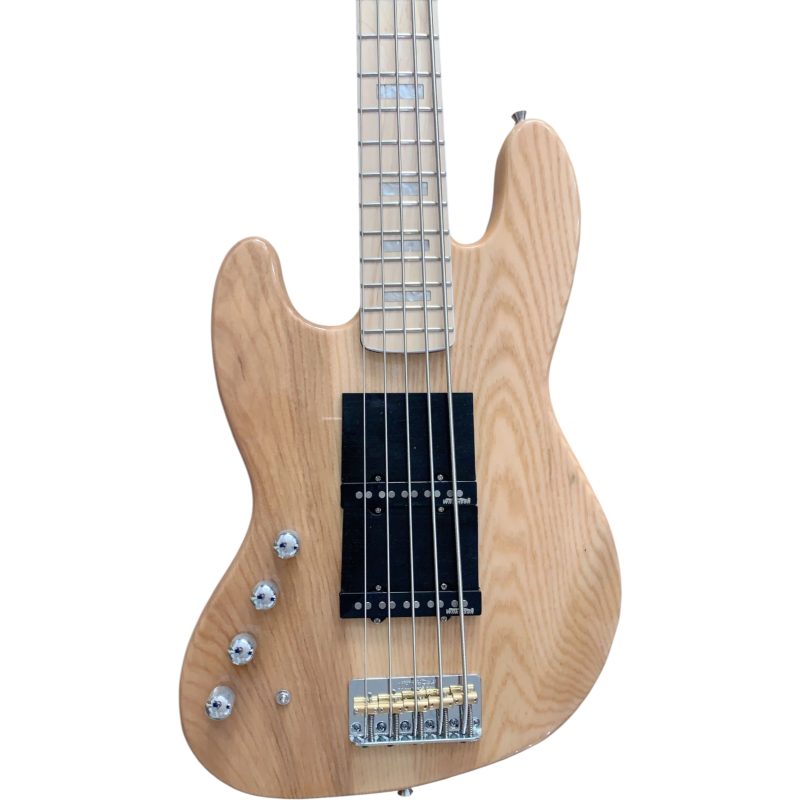
Custom Guitar Atelier currently offers several Regent Jazz Bass configurations in 5-string formats as part of its customizable bass range.
6-String Jazz Bass: For Players Who Want More
For musicians who require even greater range, a 6-string Jazz Bass opens substantial creative possibilities.
The expanded register can be particularly useful for:
- Solo bass
- Jazz fusion
- Progressive music
- Chordal playing
- Tapping
- Advanced arranging
- Studio composition
- Extended melodic bass work
A sixth string can transform the bass from primarily a supporting instrument into an even broader compositional tool.
Bassists can move between deep foundational notes, traditional bass lines, chord voicings, harmonics, and melodic phrases without leaving the same instrument.
Custom Guitar Atelier’s current Regent range includes 6-string Jazz Bass builds alongside its other extended-range bass options.
Why Build a Custom Jazz Bass?
A production bass has to accommodate thousands of different musicians.
A custom bass can begin with one musician—you.
The difference is important.
Two bassists may love the same body style while having completely different preferences for neck feel, weight, tonewood, electronics, hardware, finish, or string count.
One player may want a traditional appearance.
Another may want a modern active configuration and bold metallic finish.
Another might prioritize natural wood grain and understated appointments.
Another may want an extended-range instrument built specifically for progressive or fusion work.
Customization allows these decisions to become part of the instrument rather than compromises the player must accept afterward.
Choose the Tonewoods That Fit Your Vision
Wood selection contributes to the instrument’s physical character, appearance, weight, resonance, and overall response.
Different players prioritize different qualities.
Some prefer traditional combinations.
Others are attracted to visually striking grain patterns.
Some want to control overall instrument weight, while others prioritize a particular balance or feel.
Custom Guitar Atelier’s current Jazz Bass customization options include multiple body-wood choices depending on the individual model and selected configuration.
The important point is that wood selection should be considered as part of the complete instrument rather than in isolation.
Pickups, strings, electronics, neck construction, hardware, setup, technique, amplification, and the player themselves all contribute to the final result.
Passive or Active Electronics?
One of the most important decisions when configuring a custom bass is the electronics system.
Passive Bass Electronics
Passive systems appeal to many players because of their simplicity, natural response, and familiar control layout.
They can be excellent for musicians who want direct interaction between the pickups, controls, amplifier, and playing technique.
Active Bass Electronics
Active electronics can provide additional onboard tonal control and may allow players to adjust frequencies directly from the instrument.
For working musicians who move between different rooms, amplifiers, recording environments, and genres, onboard EQ flexibility can be extremely useful.
Neither approach is inherently better.
The right choice depends on your playing style and what you want the instrument to accomplish.
Pickups: Defining the Voice of Your Bass
Pickups are one of the most influential electronic components in an electric bass.
They help determine how the vibration of the strings is translated into the signal sent to your amplifier or recording chain.
Different pickup designs can emphasize different tonal characteristics—from vintage warmth to highly detailed modern articulation.
Custom Guitar Atelier offers pickup options depending on model and configuration, with available choices potentially including brands such as Wilkinson and other premium pickup manufacturers.
When planning your custom Jazz Bass, consider how you actually play.
Are you primarily a fingerstyle bassist?
Do you slap frequently?
Do you use distortion or effects?
Do you record direct?
Do you need aggressive definition for progressive music?
Or are you pursuing a warmer vintage-inspired bass tone?
Those answers should guide the pickup configuration.
Hardware Matters More Than Many Players Realize
Tuners, bridges, saddles, control components, and related hardware may seem secondary compared with tonewoods and pickups, but they are critical parts of a reliable instrument.
Quality hardware contributes to stable adjustment, tuning performance, accurate setup, and long-term usability.
Depending on the selected build, Custom Guitar Atelier offers compatible Wilkinson and Gotoh hardware options matched to the instrument’s configuration.
For a working musician, reliability matters.
A beautiful bass isn’t enough if it can’t perform consistently through rehearsals, sessions, and live shows.
Your Finish Should Be as Personal as Your Sound
A bass is heard—but it is also seen.
Your finish can make the difference between an instrument that feels familiar and one that immediately feels like your instrument.
The Jazz Bass silhouette works particularly well with a wide range of aesthetics.
You might choose:
Traditional:
Sunburst, black, white, natural, or other classic-inspired finishes.
Modern:
Metallic colors, matte finishes, bold solid colors, or contemporary combinations.
Stage-Oriented:
Sparkle finishes and high-impact colors designed to command attention under lighting.
Wood-Focused:
Natural and transparent finishes that highlight the grain and character of the selected woods.
Current Regent Jazz Bass examples at Custom Guitar Atelier range from classic sunburst and black to Maui Blue, matte Seafoam Green, and Sparkle Purple.
The instrument doesn’t need to resemble everyone else’s Jazz Bass.
That is exactly the point of going custom.
A Jazz Bass for Fingerstyle Players
Fingerstyle remains one of the most expressive ways to play electric bass.
Small changes in finger position and attack can produce noticeably different responses.
Playing closer to the neck can produce one character.
Moving toward the bridge can create another.
Playing softly can yield a round, controlled response, while digging into the strings can introduce additional attack and harmonic content.
A responsive Jazz Bass-style instrument allows these variations in technique to become part of the player’s tonal vocabulary.
A Jazz Bass for Slap and Funk
The Jazz Bass format has long been associated with players who demand articulation and rhythmic definition.
For slap techniques, the interaction between string attack, pickup configuration, setup, and electronics can produce a highly immediate response.
Thumb strikes need weight.
Pops need clarity.
Ghost notes need definition.
And rapid passages need enough separation that the groove remains intelligible.
For funk-oriented players, careful setup and component selection can be just as important as the body design itself.
A Jazz Bass for the Studio
Recording exposes everything.
String noise.
Uneven setup.
Poor intonation.
Weak electronics.
Inconsistent output.
A studio bass therefore needs to be more than visually impressive.
It needs to perform predictably.
A well-configured Jazz Bass can cover a broad range of recording situations—from warm supporting lines to aggressive, forward bass tones.
For musicians who record several genres, that adaptability can make a Jazz Bass-style instrument especially useful.
A Jazz Bass for the Stage
Live performance introduces another set of requirements.
The bass must remain comfortable during long sets.
Controls need to be intuitive.
Hardware must function reliably.
The instrument needs to respond consistently from song to song.
And its tone must occupy the right space in a full band.
A custom instrument gives the player an opportunity to consider these practical requirements before the instrument is built.
The goal isn’t merely to create something attractive.
It is to create something you can depend on when the lights come on.
Fretboard, Inlays, and Personal Details
Customization isn’t limited to the largest components.
Small details can dramatically influence the personality of an instrument.
Depending on the build, a player might consider:
- Fretboard material
- Fret specifications
- Position markers
- Decorative inlays
- Binding
- Pickguard design
- Hardware finish
- Control-knob style
- Headstock treatment
- Personalized logos or details
For some musicians, understatement is the goal.
For others, the bass should be a centerpiece.
A custom build allows both approaches.
Right-Handed or Left-Handed
A custom instrument should fit the player rather than forcing the player to adapt to limited factory availability.
Playing orientation can therefore be an important part of the configuration process.
Several current Custom Guitar Atelier Jazz Bass product pages include playing orientation among their customization selections.
For left-handed bassists in particular, customization can provide access to designs and specifications that may be difficult to find among standard production instruments.
The Custom Guitar Atelier Regent Jazz Bass
Within the Custom Guitar Atelier collection, the Regent name is used across a growing range of custom Jazz Bass configurations.
Current examples include:
- 4-string Jazz Bass builds
- 5-string Jazz Bass builds
- 6-string Jazz Bass builds
- Traditional and contemporary finishes
- Natural wood configurations
- Artist-inspired configurations
- Customizable materials and components
Rather than limiting every musician to one standard configuration, the Regent platform provides a starting point for creating an instrument around individual preferences.
Quality Control Before Shipment
Customization means very little if the finished instrument is not properly inspected.
Before dispatch, completed Custom Guitar Atelier instruments are checked across key areas including construction, finish, playability, hardware, electronics where applicable, tuning, intonation, setup, and overall function.
This final stage matters because the goal of a custom instrument isn’t simply to match a list of specifications.
It needs to function as a complete musical instrument.
Your Bass. Your Specifications. Your Sound.
There will never be one perfect Jazz Bass for every bassist.
And there shouldn’t be.
A funk player may want something completely different from a progressive bassist.
A touring musician may prioritize reliability and versatility.
A collector may focus on rare woods and elaborate appointments.
A studio bassist may want maximum tonal flexibility.
A traditionalist may want a straightforward four-string instrument with a timeless appearance.
The advantage of a custom Jazz Bass is that these choices can begin with the musician rather than with a factory specification sheet.
At Custom Guitar Atelier, we create custom instruments for players who want their bass to reflect the way they actually play.
Choose your string configuration.
Choose your woods.
Choose your finish.
Choose your electronics.
Choose your hardware.
Then make the instrument your own.
Discover Your Custom Jazz Bass
Explore the Custom Guitar Atelier Regent Jazz Bass collection and find a design that can become the starting point for your next instrument.
Whether you’re searching for a classic 4-string, an extended-range 5-string, a versatile 6-string, or a completely personalized configuration, our Custom Build Team can help you develop a bass around your preferred specifications.
Custom Guitar Atelier
Crafted for Your Hands. Built for Your Sound.