
Artist Spotlight & Signature Prototypes, Boutique Electronics & Tone Shaping, Custom Guitars, International Shipping & Global Logistics, Style, The Bespoke Build Process (E-E-A-T), Tonewood & Material Science
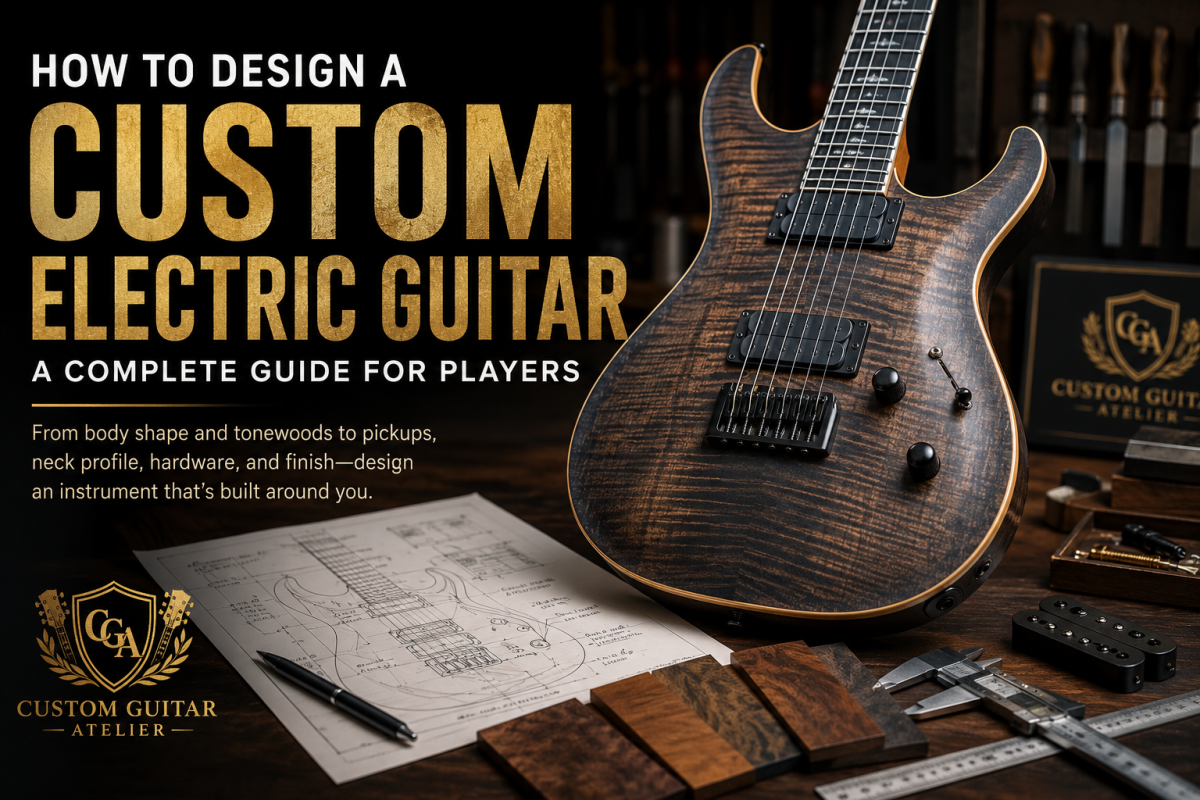
How to Design a Custom Electric Guitar: A Complete Guide for Players
Jul
There comes a point in many guitarists’ journeys when buying another off-the-shelf instrument no longer feels like the answer.
Perhaps you love the neck of one guitar but prefer the pickups of another. Maybe you want a particular scale length, a more comfortable body shape, premium hardware, a distinctive tonewood combination, or an instrument that simply does not look like every other guitar hanging on a music-store wall.
That is where a custom electric guitar becomes compelling.
A thoughtfully designed custom guitar is not merely about choosing an exotic top or an unusual finish. It is about creating an instrument in which playability, ergonomics, electronics, construction, materials, and visual identity work together around the player.
But with so many possible specifications, where should you begin?
This guide walks through the most important decisions when designing a custom electric guitar—and explains which choices deserve the most attention before a build begins.
What Is a Custom Electric Guitar?
A custom electric guitar is an instrument configured or built around a specific set of requirements rather than purchased in a predetermined mass-production specification.
Depending on the builder and project, customization may include:
- Body shape
- Body and top woods
- Neck construction
- Neck profile
- Fingerboard material
- Scale length
- Fingerboard radius
- Number and size of frets
- Pickup configuration
- Switching system
- Bridge type
- Tuners
- Hardware
- Finish
- Inlays
- Binding
- Ergonomic contours
- Personalized visual details
The degree of customization varies significantly. Some instruments are based on an established platform with selectable options, while a truly bespoke guitar may involve an original body design, unique construction details, specialized electronics, or specifications developed specifically for one player.
The key distinction is simple:
A good custom guitar begins with the player—not with a specification sheet.
1. Start With the Music You Actually Play
Before selecting woods, pickups, or finishes, define the instrument’s purpose.
Ask yourself:
- What styles do I play most often?
- Do I primarily play rhythm, lead, or both?
- Do I use clean tones, edge-of-breakup sounds, high gain, or a wide combination?
- Do I play at home, on stage, in the studio, or on tour?
- Do I frequently change tunings?
- Do I need maximum versatility or one highly focused sound?
- What do I dislike about my current guitars?
These questions are more important than choosing a visually impressive piece of wood.
For example, a player using extended chord voicings and clean tones may prioritize clarity, comfortable fret access, and articulate electronics. A high-gain player may care more about tuning stability, controlled low-frequency response, upper-fret access, and a pickup system that remains defined under distortion.
A session guitarist may prioritize versatility and low-noise switching. A touring player may place greater value on reliability, serviceability, and hardware that performs consistently night after night.
A useful starting exercise
Write down three things you love about guitars you already own—and three things you would change.
That simple list can reveal more about your ideal custom guitar than hours spent browsing photographs online.
2. Choose the Right Body Design
The body is the visual center of an electric guitar, but its importance goes beyond appearance.
A guitar’s body design affects:
- Playing position
- Balance
- Weight distribution
- Upper-fret access
- Picking-arm comfort
- Seated ergonomics
- Strap position
- Overall identity
Traditional or original body shape?
A traditional silhouette can feel immediately familiar. An original design can create a stronger individual identity and allow ergonomic elements to be reconsidered from the ground up.
At Custom Guitar Atelier, we believe a guitar should have a recognizable character of its own. That philosophy is central to original designs such as NOVARA, our flagship original guitar model.
Whether choosing an established configuration or exploring a distinctive original instrument, the important question is not simply:
“Does it look beautiful?”
It is also:
“Will this shape make me want to play for hours?”
Consider weight early
Weight should not be an afterthought.
A visually spectacular guitar that causes shoulder fatigue during a long performance may be poorly matched to its owner. Body dimensions, wood selection, chambering strategies, hardware, and construction all contribute to the final result.
For working musicians especially, comfort is a performance specification.
3. Understand Tonewoods Without Chasing Myths
Few guitar topics generate as much debate as tonewoods.
The most practical approach is to avoid treating any single wood species as a magic formula. An electric guitar functions as a complete system. Construction, pickups, strings, bridge design, setup, amplification, playing technique, and other variables all contribute to the final experience.
Wood selection can still matter to the instrument’s:
- Weight
- Stiffness
- Resonant behavior
- Attack
- Sustain characteristics
- Tactile response
- Aesthetic appearance
Common body woods
Mahogany
Mahogany is widely associated with substantial mids, a strong fundamental character, and a solid feel. It is frequently used where players want authority and body from the instrument.
Alder
Alder is a familiar electric-guitar body wood valued for its relatively balanced character and practical weight. It works across a broad range of pickup systems and musical styles.
Ash
Ash can offer striking grain patterns and is often chosen by players seeking both visual character and a responsive feel. Individual pieces can vary significantly in weight.
Basswood
Basswood is frequently underestimated because it may appear less visually dramatic than figured woods. In a well-designed instrument, however, it can be a highly practical body material, particularly when weight and a balanced overall platform matter.
Maple
Maple is dense and hard and is often used as a top rather than as an entire solid body. Figured maple—such as flame or quilt—can create dramatic visual depth.
Do not choose with your eyes alone
An expensive exotic wood is not automatically the best choice for a particular guitar.
The better question is:
How does this specific piece of material support the complete design?
A skilled custom guitar process should consider wood selection as one part of an integrated instrument—not as a list of luxury upgrades.
4. Decide on Neck Construction
Neck construction has major implications for the feel, serviceability, identity, and architecture of a guitar.
The three broad categories are:
Bolt-on neck
A bolt-on design can provide:
- Practical serviceability
- Familiar attack and response
- Efficient neck replacement when necessary
- A broad range of design possibilities
Do not mistake “bolt-on” for “cheap.” Exceptional professional instruments use bolt-on construction.
Set neck
A set neck is permanently joined to the body and is strongly associated with many classic and boutique guitar designs.
Players may choose it for:
- A seamless visual transition
- Traditional construction preferences
- A particular feel and response
- Sculpted heel possibilities
Neck-through construction
With neck-through construction, the central neck structure continues through the body.
Potential reasons to choose it include:
- Extensive upper-fret access
- A distinctive structural concept
- Smooth heel transitions
- Specific sustain and response goals
There is no universal winner. The correct construction depends on the intended instrument.
5. Treat Neck Profile as a Critical Specification
Players often spend more time discussing pickups than neck profiles.
That can be a mistake.
Your fretting hand interacts with the neck continuously. Even a beautifully made guitar may remain in its case if the neck never feels right.
Common profile descriptions include:
- C shape
- Modern C
- D shape
- U shape
- Soft V
- Asymmetrical profiles
But labels alone are inadequate. One company’s “C” can feel very different from another company’s “C.”
Important dimensions include:
- Thickness near the first fret
- Thickness near the 12th fret
- Shoulder shape
- Taper
- Nut width
- Fingerboard edge treatment
Use your current favorite guitar as a reference
One of the most useful steps in a custom project is identifying the neck you already play most comfortably.
Rather than saying, “I want a thin neck,” determine what “thin” means in measurable terms.
A custom build benefits from specificity.
6. Select the Scale Length Carefully
Scale length influences both feel and the overall design of the instrument.
Common electric-guitar scale lengths include approximately:
- 24.75 inches
- 25 inches
- 25.5 inches
Longer and extended scales are also used, particularly for lower tunings and specialized instruments.
In broad practical terms, scale length interacts with:
- Perceived string tension
- Fret spacing
- Bending feel
- Low-tuning stability
- String gauge choices
- Playing technique
A player accustomed to one scale length may immediately notice a change when moving to another.
Think about tuning before finalizing scale
A guitarist playing primarily in standard tuning has different requirements from a player regularly tuning down several steps.
Your preferred tuning, string gauge, scale length, and setup should be considered together.
7. Choose the Fingerboard Radius for Your Playing Style
Fingerboard radius describes the curvature of the fretboard surface.
A more curved board may feel familiar to players who favor traditional chord work. A flatter board is often preferred by players seeking wide bends, lower action, or technical lead performance.
Many modern custom guitars also use a compound radius, where the board becomes progressively flatter toward the higher frets.
This can offer:
- Comfortable chord work lower on the neck
- A flatter feel for upper-register lead playing
- Greater flexibility for players with mixed techniques
Again, there is no universally superior specification. The ideal radius depends on the player.
8. Choose Frets Based on Feel, Not Fashion
Fretwire influences how the guitar feels under the fingers.
Variables include:
- Width
- Height
- Material
Some players prefer tall frets because they facilitate expressive bends and reduce the need to press the fingerboard heavily. Others prefer a lower, more traditional feel.
Nickel-silver or stainless steel?
Nickel-silver fretwire remains a standard choice and is familiar to generations of players.
Stainless-steel frets are valued for exceptional wear resistance and a slick playing feel, although preferences differ.
This is a good example of why custom specification should be based on the player rather than internet consensus.
9. Design the Pickup Configuration Around Real Musical Needs
For an electric guitar, the pickup system is one of the most consequential choices in the signal chain.
Common configurations include:
- SSS — three single coils
- HSS — humbucker plus two single coils
- HH — two humbuckers
- HSH — two humbuckers with a middle single coil
- P-90 combinations
- Filter-style pickups
- Active pickup systems
- Custom hybrid arrangements
Single-coil pickups
Often selected for:
- Clarity
- Articulation
- Dynamic response
- Open high-frequency character
Traditional single coils can also be susceptible to hum, depending on the design and electrical environment.
Humbuckers
Often selected for:
- Higher output
- Fuller response
- Noise rejection
- Strong performance with overdrive and distortion
But “humbucker” is an extremely broad category. A low-output vintage-inspired humbucker and a modern high-output pickup can behave very differently.
P-90-style pickups
P-90-type designs occupy their own compelling territory, often appealing to players seeking strong midrange character, immediacy, and a different response from either a conventional Strat-style single coil or humbucker.
Output is not everything
More output does not automatically mean better tone.
The right pickup should complement:
- The player’s technique
- The instrument
- The amplifier
- The gain structure
- The intended musical context
A custom guitar should be designed as part of a complete rig.
10. Consider Advanced Switching Before Adding It
Modern wiring can dramatically expand an instrument’s tonal range.
Options may include:
- Coil splitting
- Series/parallel switching
- Phase switching
- Pickup blending
- Additional pickup combinations
- Push-pull controls
- Mini toggles
- Multi-position selector systems
These features can be useful—but complexity should have a purpose.
A guitar with numerous theoretical sounds is not necessarily more musical than a simple guitar with three exceptional sounds.
Ask:
Will I use this function during an actual song, session, or performance?
If the answer is no, simplicity may be the better design decision.
11. Select the Bridge Based on How You Play
The bridge affects the physical interface of the guitar, tuning behavior, setup, and performance possibilities.
Fixed bridge
A fixed bridge may be ideal for players who value:
- Simplicity
- Tuning stability
- Easy alternate tunings
- Straightforward maintenance
Traditional tremolo
A traditional vibrato bridge can provide expressive pitch movement while preserving a familiar playing experience.
Double-locking tremolo
A locking system may suit players using:
- Aggressive pitch effects
- Deep dives
- Extreme vibrato techniques
- Performance styles demanding strong tuning stability under heavy tremolo use
The trade-off is additional setup complexity.
Choose according to actual playing behavior—not because a particular bridge appears more technically impressive.
12. Do Not Underestimate Tuners, Nut, and Setup
Some of the least glamorous components have an outsized influence on the ownership experience.
Tuners
High-quality tuners contribute to reliability and smooth adjustment. Locking tuners can also make string changes more efficient, depending on the system.
Nut
A precisely cut nut is critical.
Poor nut work can contribute to:
- Tuning problems
- Binding
- Incorrect action near the first fret
- Intonation frustration
- Unstable performance
Final setup
Even premium components cannot compensate for a poor setup.
A professional setup should address:
- Neck relief
- Action
- Nut slot height
- Intonation
- Pickup height
- Fret condition
- Bridge behavior
- Playing style
- String gauge
- Tuning
The final millimeters matter.
13. Design the Finish Around Identity and Use
This is where a custom guitar can become deeply personal.
Possible directions include:
- Solid colors
- Transparent finishes
- Bursts
- Natural finishes
- High gloss
- Satin
- Open-pore finishes
- Metallic effects
- Hand-applied artistic finishes
- Figured-wood showcases
But the finish should support the overall design language.
A dramatic figured top may benefit from a transparent treatment. A minimalist body may look more powerful in a carefully chosen solid color. An original guitar design may call for a finish created specifically around its geometry.
The strongest custom instruments often show restraint.
More decoration does not always create more identity.
14. Balance Originality With Long-Term Playability
It is easy to become overly ambitious during a custom project.
You may be tempted to combine:
- The most exotic wood
- The most complex switching
- The highest-output pickups
- The most unusual inlays
- The most elaborate finish
- The most advanced bridge
All in one instrument.
That does not necessarily produce a coherent guitar.
Great design requires editing.
A successful custom instrument should answer a clear question:
What is this guitar meant to be?
Every major specification should support that answer.
Custom Guitar vs. Production Guitar: Which Is Right for You?
A production guitar may be the better choice when:
- You need an instrument immediately
- A standard model already fits your requirements
- Resale liquidity is a major priority
- You are still discovering your preferences
- You want to try the exact guitar before purchasing
A custom guitar may be the better choice when:
- You have clearly defined ergonomic preferences
- Standard specifications repeatedly force compromises
- You need a particular neck configuration
- You want a distinctive original design
- You require specialized electronics
- You value individual craftsmanship
- You want an instrument with a deeper personal connection
Neither category is inherently superior.
The right choice depends on the player.
Common Mistakes When Ordering a Custom Guitar
Mistake 1: Choosing every specification independently
A guitar is a system. Pickups, scale length, woods, hardware, construction, and setup interact.
Better approach: Design the complete instrument around a defined purpose.
Mistake 2: Prioritizing appearance over ergonomics
A spectacular guitar that is uncomfortable will eventually become decoration.
Better approach: Decide weight, balance, neck feel, and fret access early.
Mistake 3: Copying a favorite artist’s specifications exactly
Your hands, rig, technique, tuning, and musical context may be completely different.
Better approach: Understand why a specification works for that artist before adopting it.
Mistake 4: Adding features because they are available
More switches do not automatically create a better instrument.
Better approach: Include options you can realistically imagine using.
Mistake 5: Being vague about the neck
Terms such as “fast,” “chunky,” and “modern” are subjective.
Better approach: Use measurements and physical reference instruments whenever possible.
Mistake 6: Ignoring the amplifier and signal chain
A pickup does not exist in isolation.
Better approach: Discuss the amplifiers, modelers, pedals, tuning, and gain levels you actually use.
A Practical Custom Guitar Checklist
Before approving a custom electric guitar specification, document the following:
Musical purpose
- Primary genres
- Clean or high-gain emphasis
- Rhythm or lead priority
- Stage, studio, or home use
Ergonomics
- Target weight
- Seated comfort
- Strap balance
- Upper-fret access
Neck
- Scale length
- Nut width
- Neck profile
- Thickness measurements
- Fingerboard radius
- Fret size
- Number of frets
Construction
- Bolt-on
- Set neck
- Neck-through
- Other specialized architecture
Electronics
- Pickup types
- Pickup configuration
- Control layout
- Switching options
- Coil functions
Hardware
- Fixed or tremolo bridge
- Tuner type
- Hardware finish
- Strap system
Aesthetics
- Body design
- Wood appearance
- Color
- Finish type
- Binding
- Inlays
- Custom details
Setup
- Primary tuning
- String gauge
- Preferred action
- Playing technique
This checklist can prevent expensive misunderstandings and improve communication throughout the project.
Frequently Asked Questions About Custom Electric Guitars
Is a custom guitar worth it?
A custom guitar can be worth it for a player who understands their preferences and wants specifications that standard production instruments do not provide. Its value is strongest when customization solves real problems involving playability, ergonomics, sound, functionality, or artistic identity.
How do I choose a custom guitar builder?
Evaluate the builder’s design philosophy, craftsmanship, communication, portfolio, specification process, quality control, and ability to understand your needs. Do not choose solely from photographs.
What should I customize first?
Start with the elements that most directly affect your playing experience: body ergonomics, neck profile, scale length, fingerboard radius, fret preferences, bridge system, and pickup requirements.
What is the best wood for a custom electric guitar?
There is no single best wood. The appropriate choice depends on the complete design, desired weight, construction, availability, stability, aesthetics, and the player’s goals.
Should I choose passive or active pickups?
Passive pickups cover an enormous range of traditional and modern sounds. Active systems can offer specific output, consistency, noise, and frequency-response characteristics. The correct choice depends on your rig and musical requirements.
Is an expensive custom guitar automatically better?
No. Price alone does not guarantee that a guitar will suit a specific player. Specification coherence, craftsmanship, setup, material selection, quality control, and compatibility with the musician matter more than prestige alone.
Can a custom guitar be designed for lower tunings?
Yes. Scale length, string gauge, bridge design, nut work, pickups, setup, and overall construction can be planned around lower tunings.
Final Thoughts: Build Around the Player
The best custom guitar is not the instrument with the longest specification list.
It is the guitar in which every major decision feels connected.
The neck fits the hand.
The body balances naturally.
The scale supports the tuning.
The pickups complement the rig.
The hardware serves the technique.
The finish expresses an identity.
The complete instrument invites the player to keep playing.
That is the real promise of a custom electric guitar.
At Custom Guitar Atelier, we approach the guitar as more than a collection of premium components. We believe exceptional instruments begin with a clear understanding of the musician, the music, and the experience the guitar is intended to create.
Explore the world of Custom Guitar Atelier and discover distinctive instruments—including NOVARA, our flagship original guitar design.
Your sound should not be an afterthought. Your instrument should not be either.